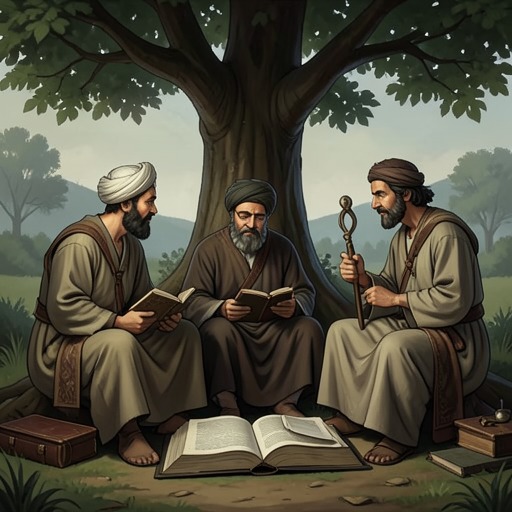
Pi's religious syncretism
Life of PiPi's religious syncretism is not simply a theory of tolerance but a sustained practice of devotion across Hinduism, Christianity, and Islam. It begins in childhood through ritual and sensory experience, becomes visible in the competing claims of religious leaders, and continues at sea through adapted forms of worship. The faiths remain recognizable in their separate ceremonies and objects, while Pi's commitment to each makes their coexistence a defining part of his religious life.
Early Formation and Religious Experience
As a baby, Pi was taken to a Hindu temple by a maternal aunt. He had no conscious memory of the visit, but later understood the temple's atmosphere and ceremonies as the beginning of a religious attachment that continued to grow. His Hindu identity was bound to the forms through which worship reached him: temple images, offerings, bells, lamps, songs, and acts of reverence. These details matter because his faith is presented as embodied and habitual, not as an abstract position adopted after comparing doctrines.
That early attachment also gave Pi a way to understand the sacred. He felt at home in a Hindu temple and experienced its central image as a presence greater than an ordinary person. Worship involved familiar gestures and offerings, as well as an understanding of the universe shaped by Hindu thought. In this account, religious belonging begins in repeated encounters with places, objects, and actions; intellectual explanation follows rather than replacing them.
Pi's encounters with Islam similarly proceed through practice. While visiting a baker, he witnessed the man interrupt his work, unroll a carpet on the flour-covered floor, and pray. The sequence of standing, bowing, kneeling, and prostrating struck Pi as both physical and compelling. Later, he attended prayer at a mosque, where worshippers formed shoulder-to-shoulder rows, and found that lowering his forehead to the ground felt deeply religious. The movement from observation to participation shows how another tradition became meaningful to him through its bodily discipline and communal order.
The Muslim he came to know was a Sufi who described a personal, loving relation with God and sought union with the divine. Pi's interest therefore encompassed more than the visible actions of prayer: he was drawn to a conception of devotion grounded in love and closeness to God. His attention to Islam did not displace his Hindu formation or make his Christian practice insincere. The narrative presents these attachments accumulating rather than cancelling one another.
A Plural Practice Becomes Public
For a time, Pi's religious activities were noticed mainly by people who found them amusing or unimportant. That changed when the religious leaders who saw him at their places of worship confronted his family. At a meeting attended by a Hindu pandit, a Christian priest, and an imam, each claimed Pi as a faithful member of his own tradition. The priest identified him as a Christian who attended church; the imam pointed to his regular attendance at Friday prayer and growing knowledge of the Qur'an; and the pandit cited his visits to the temple and participation in worship there.
Their disagreement turned on the assumption that religious commitment must be exclusive. The leaders accepted that Pi was devout but insisted that he could not belong to all three traditions and must choose one. Their own exchange made the conflict visible: instead of treating the practices as evidence of sincere devotion, they disputed which single identity could properly contain him. Pi's plural faith thus challenged a boundary maintained by the representatives of the faiths themselves.
Asked to respond, Pi invoked Mahatma Gandhi's view that religions are true and expressed his desire to love God. His answer did not resolve the doctrinal disagreement or persuade the leaders to recognize a new shared category. It did, however, state the principle by which he understood his own practice: devotion mattered more to him than exclusive affiliation. The moment also shows that his pluralism was personal and earnest, not a performance designed to provoke the adults around him.
Commitment Through Objects and Ritual
Pi's wish to deepen his Christian practice became concrete when he asked his father to be baptized and requested a prayer rug. His mother later argued that he should be either Hindu, Christian, or Muslim, repeating the demand for a single identity. Pi answered by comparing religious belonging to having more than one national identity. The exchange reveals how difficult his position was for his family to classify, even when it was expressed as a sincere commitment rather than a rejection of any one tradition.
The prayer rug gave his Muslim practice a durable, portable form. Though ordinary in quality, it was precious to him. Its red ground and gold lines marked the direction of prayer, and its small dimensions made a place for worship wherever it was laid. Pi understood the ground beneath it as sacred, so the rug shaped his relation not only to prayer but also to the surrounding space. He usually prayed in a secluded corner of the yard, facing Mecca by means of a line he scratched into the pale earth and maintained. His family gradually grew accustomed to seeing him pray there.
His baptism was an awkward family occasion: his mother cooperated, his father watched without warmth, and Ravi was absent because of a cricket match. A small amount of water ran over Pi's face and neck, an outward sign of a commitment that now stood alongside his Hindu and Muslim practices. The contrast between the ceremony's modest scale and its importance to Pi underscores the personal nature of these commitments. The rug and baptism do not merge the traditions; they give each a distinct place in his devotional life.
Faith Adapted at Sea
During his ordeal at sea, Pi continued religious practice by adapting it to the absence of ordinary institutions and materials. He held solitary versions of Mass without a priest or consecrated hosts, performed Hindu acts of devotion without images, and used turtle meat as an offering. He also prayed to Allah despite not knowing the direction of Mecca and making mistakes in Arabic. These improvised rites preserved recognizable elements of several traditions while acknowledging the severe limits of his circumstances.
The practices brought him comfort, but the account does not present comfort as constant or effortless. Pi describes faith as requiring trust and openness, yet records periods of anger, exhaustion, and desolation when devotion itself became difficult. At such times he deliberately named the things around him as parts of God's creation: a makeshift turban fashioned from what remained of his shirt, his clothes, Richard Parker, the lifeboat, the sea around him, and the sky. The repeated act of naming offered a way to place his immediate world within a religious frame.
That frame did not erase the world's dangers or make every object reassuring. Pi's clothing was coming apart, Richard Parker remained dangerous, the lifeboat felt like confinement, the sea threatened his life, and he sometimes felt that God was not listening. The contrast between his declarations of sacred belonging and the hardship of his conditions gives the practice its force: it was a deliberate effort to sustain faith amid doubt, not evidence that doubt had disappeared. The despair eventually passed, sometimes as practical demands returned his attention to survival and sometimes as thoughts of his family steadied him. Pi's religious pluralism therefore persists at its most tested point as repeated devotion across traditions, sustained through concrete acts rather than resolved into a single label.